
Presidency University Kolkata M.Sc Physics: Fees 2026, Admission Dates, Course Duration, Eligibility

Presidency University Kolkata offers M.Sc Physics as a 2 Year Full Time program. For admission into Presidency University Kolkata M.Sc Physics, a candidate must clear Graduation.
Presidency University Kolkata total tutuion fees for M.Sc Physics in 2021 is ₹ 3,840 for the complete course duration. M.Sc Physics total fee at Presidency University Kolkata is ₹ 4,590 in 2021.
Course Fees
Course Duration
2 YearsTuition Fees
1.92 K1 Year Fees
2.3 KTotal Fees
4.59 KDetailed Fees
| Year | 1 | 2 |
|---|---|---|
| Total Year Wise fees | ₹2,295 | ₹2,295 |
| Total Fees | ₹2295 | ₹2295 |
| Tuition fees | ₹1920 | ₹1920 |
| Exam fees | ₹375 | ₹375 |
Course Description
Master of Science in Physics Top Colleges, Syllabus, Scope and Salary
M.Sc. in Physicsis a postgraduate course based on the study of all branches of Physics. A candidate has to be a B.Sc. graduate in Physics from a recognised university in order to become eligible for this course. M.Sc. Physics is a two year program. If the course is pursued through correspondence then the duration of the course is two years minimum and three years maximum.
Top Institutes Offering M.Sc. Physics are:
- Ramjas College, New Delhi
- HansRaj College, New Delhi
- St. Xaviers College, Kolkata
- Hindu College, New Delhi
- Miranda House College, New Delhi
The mode of admission in some colleges is through an Entrance Examination while in others it is based on merit marks of the qualifying exam.
The average tuition fee for the entire course ranges between INR 25,000 to 1.5 Lacs.
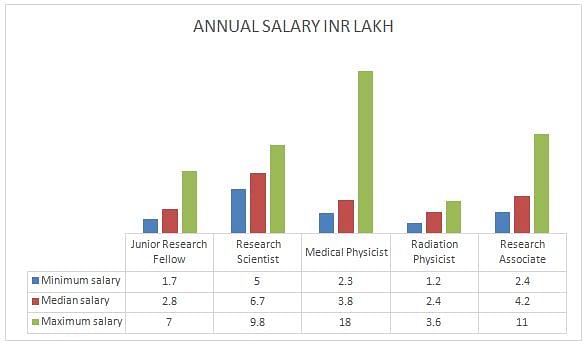
M.Sc. Physics graduate can get jobs in Research labs, academic and education institution, atomic and space organisation, meteorology departments, medical industryetc. and can work asResearch Scientist, Lecturer/professor, medical physicist, radiation physicist etc.A fresh graduate of this course can expect an average annual salary of INR 1 Lakh to INR 2.5 Lakhs.
M.Sc. Physics: Course Highlights
|
Course Level |
Post Graduate |
|
Duration |
2 years |
|
Examination Type |
Yearly System |
|
Eligibility |
B.Sc. in Physics with 50% aggregate |
|
Admission Process |
Entrance Exams |
|
Course Fee |
INR 25,000 to 1.5 Lacs |
|
Average Starting Salary |
INR 1- 2.5 Lac |
|
Top Recruiting Organizations' |
Maruti Udyog, Tech Mahindra, Infosys, Wipro, CTS, etc |
|
Top Job Profiles |
Junior Research Fellow, Research Scientist, Medical Physicist, Radiation Physicist, Research Associate. |
M.Sc. Physics: What is it about?
Physics is a branch of science which is concerned with the study of matter and energy and the interaction between them. The course also imparts knowledge on the fundamental principles of several branches in Physics.
This course also covers the basic knowledge of various specialisations like nuclear physics, high energy physics, condensed matter physics, astrophysics, cosmology, medicine, mining, geophysics.
This course is completed over the duration of 2 years.The course follows the semester system over annual mode and hence the course is divided in 4 semesters.
For students pursuing the course through correspondence, the duration of the course is minimum 2 years and maximum of 3 years.
Academic Options after M.Sc in Physics
After this Masters course, students can opt for M.Phil.and Ph.D. in Physics or a specialization in Physics from colleges like BITS Pilani,Indian Institute of Technology, Hyderabad, Loyola College, Chennai etc.
Students can also opt for a part-time Ph.D. in Physics from colleges like Lovely Professional University.
Students also have the option of pursuing a diploma in Radiology and Medical Physics from colleges like Amrita VishwaVidyapaeetham University.
M.Sc. Physics: Top Institutes
M.sc Physics is a course that is usually found in many colleges. top colleges for M.Sc. Physics are as follows:
|
Name of College |
Location |
Average Fee (in INR) |
|---|---|---|
|
Kollam |
83,600 | |
|
Chennai |
5,950 | |
|
Karnataka |
31,800 | |
| Bangalore | 77,500 | |
|
Kanpur |
49,000 | |
|
Pune |
20,000 | |
|
Ranchi |
13,800 |
M.Sc. Physics: Eligibility
The candidate must have passed 10+2 or equivalent examination by a recognised board and BSc Physics with 50% or above marks in aggregate.
OR
The candidate must have passed B.Sc. (General/Programme/B.Sc. (Pass) B.Sc. (H) Electronic, B.A. /B.Sc. (H) Instrumentation B.A./ B.Sc. (H) Electronics with 50% or above marks in aggregate.
M.Sc. Physics: Admission
The admission to the program is based on performance in the Entrance Examination and/or the academic record of the student in graduation.
Some of the Entrance Exams for M.Sc. in Physics is as follows:
CUCET: Central Universities Common Entrance Test is an exam by eight central universities in India. The application forms are available online from April and the exam is conducted in the month of May.
DUET: Delhi University Entrance exam for Physics is conducted in the month of June. The application forms are available in the month of April.
NITTET: National Institute of Technology conducts an entrance exam in the month of June. The application forms are available in the month of April and the exam is held in May.
M.Sc. in Physics Entrance Exam
The entrance exam paper will consist of 100-150 multiple choice and cross-matching type questions.
The time duration of the exam is 2.5 to 3 hours.The paper has negative marking of 0 to 1 for every wrong answer.
M.Sc. in Physics Selection Process
Selection to the M.Sc. in Physics program is based on both Entrance Exam (85%) and the academic record of the student (15%) in graduation.
Colleges like Sikkim ManipalUniversity which do not take Entrance Exam bases its selection process on the merit marks obtained in qualifying examination.
M.Sc. Physics: Syllabus and Course Description
This course is aimed at imparting knowledge on the fundamental principles of Physics.
The course delivery method in M.Sc. Physics include seminars, lectures, workshops and practical lab work.
Students will be required to complete a research project towards the last two semesters and this forms an integral part of the syllabus for the course. In the final evaluation, class assignments, end-semester exams, internships and project reports are taken into account.
There might be variations in the syllabus from college to college. The syllabus is divided into Core and Elective courses. A detailed syllabus is as follows:
|
Name of Subject |
Topics |
Description |
|---|---|---|
|
Mathematical Methods |
Functions of a complex variable, Linear Differential Equations & Special Functions, Partial Differential Equations and Green Function Method, Elements of Group Theory, Integral Equations, Fourier and Laplace transforms, Green’s functions for ordinary and partial differential equations of mathematical physics, Tensor analysis |
This is a course on the mathematical methods in Physics |
|
Classical Mechanics |
Newtonian mechanics and its limitations, Central force, Principle of least action, Canonical Transformations, Small Oscillations |
This course is on basic principles of mechanics |
|
Quantum Mechanics |
Mathematical tools, Fundamental Concepts of Quantum Mechanics, Angular Momentum, Identical Particles, Symmetries, Approximation methods, Scattering theory, The Klein Gordon equation, The Dirac equation, Covariant form of the Dirac equation, Conjugate Dirac spinor and its Lorentz transformation, Boosting the wave function from the rest frame, Dirac’s hole theory and charge conjugation, Foldy- Wuthuysen transformations, The Hydrogen atom |
This course is to impart knowledge on basic principles of quantum mechanics |
|
Electronics |
Semiconductor Devices, Feedback Principle, Microwave Electronics, Passive Networks, High Frequency Transmission Line, Active Circuits, Op-Amp Circuits, Voltage Regulators, Elements of Communication Electronics, Digital Circuits |
This course is about the study of electronics in physics |
|
Solid State Physics |
Crystalline and amorphous solids, X-ray diffraction by crystals, Types of bonding, Vibrations of one-dimensional monatomic and diatomic lattices, Magnetic properties of solids, Quantized free electron theory, Intrinsic and extrinsic semiconductors, Energy bands in solids |
This course is based on principles in solid state physics |
|
Atomic Spectroscopy |
General discussion in Hydrogen spectra, Spectra of divalent atoms, Hyperfine structure in spectra of monovalent atoms, Lasers in Spectroscopy, Superconductivity |
The importance and use of atomic spectroscopy is the focus of this course |
|
Nuclear Physics |
General properties of nuclei, Two-nucleon problem and nuclear forces, Nuclear models, Particle accelerators, Beta and Gamma decay, Energy loss of charged particles, Reactor Physics, High energy physics |
This course is about the principles of Nuclear Physics |
|
Relativity and Cosmology |
Review of special theory of relativity, Review of tensor calculus, Einstein’s field equations, Applications of general relativity, Gravitational Collapse and Black Holes, Cosmology |
This course studies the relationship and the interaction of relativity and cosmology in Physics |
|
Classical Electrodynamics |
Scattering, Magneto hydrodynamic (MHD) equations, Orbit theory of drift motions in a plasma, Propagation of EM waves through plasma, Multiple radiation |
This course is about the principles of electrodynamics |
|
Advanced Optics |
Basic Laser Theory, Basic Laser Systems, Laser Beam Propagation, Nonlinear Optics, Holography, Transient effect, Fibre optics, Detection of optical radiation |
Here, the fundamentals of optics and optic theory is the base of the course |
|
Statistical Mechanics |
Scope and aim of statistical mechanics., Stationary ensembles, Density matrix, Distribution functions, Ideal quantum systems, Strongly interacting systems, Phase transition, Fluctuations |
This course is on primary principles of mechanics |
|
Group Theory |
Abstract group theory, Representation theory, Continuous group, Application in Physics |
This course is about the importance of group theory in physics |
|
Molecular Spectroscopy |
Born-Oppenheimer approximation and separation of electronic and nuclear motions in Molecules, Microwave and far infrared spectroscopy, Infrared spectra, Raman spectroscopy, Vibrational spectra of poly atomic molecules, Electronic spectra of diatomic molecules, Hydrogen molecule ion and molecular orbital, Basic aspects of photo physical processes, Application of group theory to spectroscopy |
This course focuses on study on molecules. |
|
Astrophysics |
Stellar Structure and Evolution, Nuclear Astrophysics, Stellar Objects & Stellar Explosions, Gravitational Collapse and relativistic Astrophysics, Accretion disks |
This is a course on the study of planetary movements, gravity etc. |
M.Sc. Physics: Career Prospects
With a comprehensive knowledge about concepts in Physics, students with M.Sc. Physics degree can find employment in private as well as in Government sector. One can look for jobs in research labs, medical labs, academic institutions, IT field, technical field, automobile industry and various government owned Scientific Research and Development Organizations. Other than these options a Physics graduate have the option even to step ahead for civil services for which one is supposed to clear civil service exams conducted by UPSC.
According to the projection made by BLS, during 2012-2022 jobs for physicists would go up by 10%. A physicist is lucky enough to get job anywhere he/she wants to. Teaching profession is also open to a Physics graduate.
Some of the major private companies having a large scope of employment for M.Sc. Physics students are:
- Maruti Udyog
- Tech Mahindra
- Infosys
- Wipro
- CTS
While in Government sector major recruiting organizations are:
- Bhabha Atomic Research Centre (BARC)
- Oil and Natural Gas Corporation (ONGC)
- Bharat Heavy Electricals Limited (BHEL)
- National Thermal Power Corporation (NTPC)
- Indian Space Research Organization (ISRO)
M.Sc. Physics: Job Profiles
Various job profiles and their description in above listed companies are:
|
Job Profile |
Description |
|---|---|
|
Junior Research Fellow |
A Junior research fellowship prepares candidate to take on the role of a university professor. If the work of the junior research fellow is satisfactory, they are promoted to senior research fellow. |
|
Research Scientist |
A research scientist is hired to carry out researches in the said field and design and conduct experiments to make significant contributions to the study of physics. |
|
Medical Physicist |
The job of the medical physicist involves the development of techniques and equipments that would be used by medical staff to diagnose illness and treat patients. |
|
Radiation Physicist |
The prime job of the radiation physicist is to ensure the smooth functioning of medical devices which use radiation. |
|
Research Associate |
They are professionals hired to carry out research and be a part of an ongoing research program within a research facility. |
M.Sc. Physics: Salary Trends
There are so many jobs for physicist in every sector that one is never worried about the amount of money he/she will get after his/her degree in Physics. Even in past few years demand for physicist have increased so much that salary trend for physics graduate looks very optimistic. Among cities, Hyderabad had the highest salary hike of almost 25% for analytics professionals. However IT sector offers the best salary packages to job seekers. Average salary in this sector ranges between 3 lakhs to 7 lakhs for entry level candidates with a regular growth rate of 30% every year.
Given below is the graph showing salary trend of various job profiles on which a physicist can work:
Course Details
Fees for the self-financed international students is US$ 1,000/- per semester (all inclusive excluding hostel facilities) for undergraduate and post graduate courses.
At the PG level, Presidency University Kolkata offers full-time MA and M.Sc courses in multiple electives at the PG level. For admission to MA and M.Sc program candidates should have a BA(Hons) and B.Sc(Hons) in the relevant discipline for MA and M.Sc courses respectively.
Admission is offered on the basis of candidates’ score in PUMDET organized by WBJEEB. WBJEEB finalizes the admission after conducting counselling rounds for the selected candidates as per PUMDET merit list.
| Course Name | Specialization | Eligibility Criteria | Selection Criteria |
|---|---|---|---|
| MA | Bengali | Bachelor's degree with 50% in Bengali (Honours) | PUMDET score followed by counselling |
| English | Bachelor's degree with 50% in English (Honours) | ||
| Hindi | Bachelor's degree with 50% in Hindi (Honours) | ||
| History | Bachelor's degree with 50% in History (Honours) | ||
| Philosophy | Bachelor's degree with 50% in Philosophy (Honours) | ||
| Sociology | Bachelor's degree with 50% in Sociology (Honours) | ||
| Political Science | Bachelor's degree with 50% in Political Science (Honours) | ||
| M.Sc | Life Sciences | Bachelor's degree with 60% marks in B.Sc. with Honours in any branch of Biological Sciences | PUMDET score followed by counselling |
| Chemistry | Bachelor's degree with 60% in Chemistry (Honours) | ||
| Geography | Bachelor's degree with 60% in Geography (Honours) | ||
| Applied Economics | Bachelor's degree with 60% in Economics (Honours) | ||
| Applied Geology | Bachelor's degree with 60% in Geology (Honours) | ||
| Mathematics | Bachelor's degree with 60% in Mathematics (Honours) | ||
| Physics | Bachelor's degree with 60% in Physics (Honours) | ||
| Statistics | Bachelor's degree with 60% in Statistics (Honours) |
Presidency University Kolkata PUMDET 2020
For the academic year 2020-21, WBJEEB is going to conduct a common entrance examination (PUMDET 2020) to offer admission in MA/ M.Sc (H) courses offered by Presidency University, Kolkata.
Candidates have to answer 50 MCQs of 100 marks for the duration of 2 Hours. Each correct response will yield two marks while a wrong answer will result in the deduction of 1/2 mark.
Presidency University, Kolkata PUMDET Merit list: WBJEEB will publish a merit list on the basis of candidates’ marks in the entrance test. Final rank list can be availed from the official website of WBJEEB portal only.
Those who will maintain a position in the General Merit Rank (GMR) List will be called for counselling rounds at:
West Bengal Joint Entrance Examinations Board,
Aq-13/1, Sector – V, Saltlake,Kolkata– 700091
Land Mark: Near Technopolis /215a Bus Stand
Note: Final admission on the basis of counselling is subject to rules prescribed by Presidency University, Kolkata.
Documents required at the time of PUMDET counselling:
- Downloaded copy of ‘Registration Form of PUMDET-2020”
- Downloaded copy of Rank Card of PUMDET 2020
- Two recent Passport size colour photography
- Original Mark Sheet of 10+2 or equivalent
- Caste certificate for reserved categories
Note: Admission fee is required to be paid at the time of final counselling round in the form of DD drawn in favour of “West Bengal Joint Entrance Examinations Board” payable at Kolkata.
Presidency University, Kolkata PUMDET Application Form 2020
PUMDET application form can be filled online only form WBJEEB portal by following the below-listed steps:
- Visit the official WBJEEB portal and fill the application form.
- Upload scanned copies of the desired documents.
- Pay the application fee of INR 500 by Credit/ Debit Card or through Net-Banking.
- After completing all the application related formalities, download the ‘Confirmation Page’ for further usage.
In the case of any admission related queries contact to:
Controller of Examinations,
West Bengal Joint Entrance Examinations Board,
AQ-13/1, Sector –V, Salt Lake City, Kolkata-700091
Examination Helpdesk: 1800-1023-781, 1800-3450-050
Placement
| Highest Placement | ₹ 13.0 Lakhs |
| Average Placement | ₹ 5.0 Lakhs |
| Top Companies |   .png?tr=h-50,w-100,c-force)    |
College Ranking
Ranking of Presidency University
Ask your question
Answered Questions
Presidency University: 30 answered questions
The admission procedure followed at Presidency University for Post Graduation is through the entrance examination. As per the government of West Bengal, 60% of seats are reserved for internal students. The rest of the seats are open to all students.
Departments like Political Science, English, History, and Physics conduct separate admission examinations. But for the finalized ranking, the examination scores and the aggregate percentage of board exams are taken and combined together.
Hindi and Philosophy departments consider the marks of the board examination. But, a final combination of the subject and the aggregate score is generally accepted to declare admission.
However, if you want to get further into the details about it, you can visit the webpage of the institute to run a check on how their admission process goes by and their subject-specific norms.
If Presidency University Kolkata is your dream college then you must have a solid academic record. Your board exam marks matter a lot. But entrance exam scores will be highly emphasized.
You will be asked about the recent developments in the field along with the questions related to class 11th and 12th. Go through R.G Collingwood, Ideas of history, and Glean information from graduate-level books like R.S Sharma, Sumit Sarkar, and Shekar Banerjee.
Having knowledge of post-modern theories like subaltern, queer theory, and genocide concepts will come in handy. Be up-to-date with all these concepts. Another key factor here is your English language skills. You are supposed to write the paper in English. Be careful of what you write and try to make it as thoughtful and transparent as possible. Try to be on point and avoid making convoluted sentences.
If you check all the above-mentioned factors, it's almost certain that you will get into Presidency University Kolkata.
Between Calcutta University and Presidency University for a PG, you should opt for Presidency University. Having studied in Calcutta University, I suggest you go for Presidency instead.
- Calcutta University is known to provide low marks to students.
- The teachers are part of the board or question setter which doesn't give good marks and a student has to study under them.
- Apart from this, there are certain colleges that, to improve their grades, give good marks to the students.
- Both of these cases are not good. Along with this, the marks get worse as the answer sheets are not checked by the college faculty and are instead checked by someone else.
- The Presidency won over these things. A student scores good marks in Presidency.
- The teachers are not that strict and they only check the answers sheets.
- As it's only the college teachers who do the questions and answers work in the exam, once getting familiar with them will help a student score well.
Therefore, it's better to opt for Presidency University. Due to its better faculty, facilities and overall experience.
You certainly can. If the registration process is completed by you already, make sure you take your TC and mark sheet from there. Your mark sheet should have an "admission canceled" stamp to it otherwise it would not be approved. You may also be required to write a letter sent to the authorities. It will cost you a sum of ?1000-1500 which would have to be deposited as a TC fee.
In case you have missed your registration, make sure you get in touch with the staff of the office. They will help you get your admission canceled.
Although this is a rare situation, in case you are lucky, they may give back your admission fee too.
No, there is no uniform at Presidency University. Being a student at Presidency University, I can assure you that there are no strict rules considering clothes.
In University your nature matters more than what you wear. Decent clothing at the campus is expected and how you carry it.
At Presidency University nobody wears a uniform as told by the authority and it is expected to continue further too.
Therefore, there is no uniform at Presidency University. Students are free to wear whatever they want. But to maintain decency at the university campus by wearing decent clothes.
If you are looking for a reputed university to pursue your higher education in India, there are several options available to you. Some of the most renowned institutions in the country include NIT Rourkela, St. Stephen’s Delhi, St. Xavier’s, and Presidency University Kolkata.
If you are passionate about your field of study, it is possible to excel and succeed regardless of where you study. However, there are several factors to consider when choosing a university, such as location, reputation, course offerings, and career prospects.
If you are from Kolkata, you may want to consider St. Xavier's or Presidency University Kolkata. These institutions are well-respected and offer a range of courses across different disciplines.
On the other hand, if you are seeking a university that offers excellent placement opportunities with top-notch industries, NIT Rourkela may be a good choice for you. This institution is known for its strong industry connections and has a track record of producing successful graduates.
It is essential to choose a university that is the right fit for your needs and goals. Here are some factors to consider when making your decision:
- Location: Consider the location of the university and whether it is easily accessible to you.
- Reputation: Research the reputation of the university and its academic programs. Look for rankings, reviews, and feedback from current and former students.
- Course offerings: Consider the courses offered at the university and whether they align with your interests and career goals.
- Career prospects: Look into the placement record of the university and whether it has strong connections with top employers in your field.
Ultimately, it is important to choose a university that resonates with you and supports your personal and professional growth.
Presidency University, Kolkata is certainly not overrated. With a legacy of over 200 years, the university has maintained its well-deserved place in Asian history. It has been widely covered by Google Art & Culture. Presidency University alumni list includes 3 Nobel laureates. The high ranking of Presidency University is well-justified.
Well, both the colleges hold their own places in English Honors at the Undergraduate level. But, this is the tough one as you won’t really get a definite answer. Jadavpur students will claim their institute is better and so will the Presidency students.
Moreover, both the universities are undoubtedly the best for any stream in Humanities. I know people from both the institutes and based on the interactions I had with them I will suggest you go for JU. It will offer you better exposure, academics, faculty, ambiance. JU’s entrance examination is also more competitive.
Few of my friends appeared for both the exams. And only the best managed to get into JU. While quite a few cracked Presidency University. As Presidency University looks at your current skills, on the other hand, Jadavhpur wants you to not only focus on writers’ current and past but also on different aspects like theatre as well.
Presidency University Kolkata is one of the most prestigious colleges in Kolkata. Getting admission at the university with a rank of 187 in the PUBDET Eco Honors will be quite difficult but wait for the third list. In the meantime, you should apply to other institutions.
The Dept. of Economics in Presidency is highly sought after by aspirants because of the top-notch faculty & an illustrious history of creating world-renowned economists.
Assuming that you’re a fresher, it will be better if you apply to other good colleges namely Lady Brabourne and Shri Shikshayatan. This way you will have a backup plan.
No, Presidency University Bangalore is entirely different from Presidency University Kolkata. The key points of difference between the two institutes are stated below in the following points.
- The Presidency University at Bangalore is a private university, which was newly established in 2013. But, Presidency University, Kolkata is a 200-year old premier institute.
- Presidency College became a university in 2010, even before Presidency Bangalore was established. It is now fully funded by the government of West Bengal.
- In Presidency University, Kolkata, many eminent personalities studied during their era. For example, Prof. S. N. Bose, Netaji Subhas Chandra Bose, Dr. Rajendra Prasad (India’s first president), Satyajit Ray, Prof. M. N. Saha, Dr. Amartya Sen (Nobel Laureate in economics), etc.
- The list of professors of Presidency University Kolkata has several pioneers including Sir J. C. Bose (father of the modern semiconductor radio), Henry Derozio (Bengal Renaissance pioneer), Prof. P. C. Roy (Chemist), Prof. A. K. Roychoudhury (invented the Roychoudhury’s equation for GTR), Dr. P. C. Mahalanabish (founder- Indian Statistical Institute), etc.
The lists of eminent personalities who have either studied at or lectured in Presidency University, Kolkata is endless. It is a heritage university, located in the heart of the city.
Similar Colleges You Might Be Interested In
- Similar Colleges
- Near By
![Apex University - [AU]](https://staticstage.collegedunia.com/public/college_data/images/appImage/1558765206Untitled.png?tr=h-100,w-200,c-force)


![Bishop Heber College - [BHC]](https://staticstage.collegedunia.com/public/college_data/images/appImage/667_BHCT_APP.jpg?tr=h-100,w-200,c-force)
![Sasmira's Institute of Management Studies and Research - [SIMSR]](https://staticstage.collegedunia.com/public/college_data/images/appImage/18704_SASMIRA_NEW.jpg?tr=h-100,w-200,c-force)
Sasmira's Institute of Management Studies and Research - [SIMSR]
Mumbai, Maharashtra
Loyola Academy Degree and PG College
Secunderabad, Telangana

![Rajiv Gandhi Institute of Information Technology and Biotechnology - [RGITBT]](https://staticstage.collegedunia.com/public/college_data/images/appImage/_R1.jpg?tr=h-100,w-200,c-force)

![IIMT University - [IIMTU]](https://staticstage.collegedunia.com/public/college_data/images/appImage/1587390118IIMTUfront.jpg?tr=h-100,w-200,c-force)
![Indian Maritime University - [IMU]](https://staticstage.collegedunia.com/public/college_data/images/appImage/1601814011Cover.jpg?tr=h-100,w-200,c-force)
Indian Maritime University - [IMU]
Kolkata, West Bengal![The Neotia University - [TNU]](https://staticstage.collegedunia.com/public/college_data/images/appImage/151426811920171225.png?tr=h-100,w-200,c-force)
Students also visited
![Apex University - [AU]](https://staticstage.collegedunia.com/public/college_data/images/logos/1558089425imageedit171019197961.png?tr=h-40,w-40,c-force)


![Bishop Heber College - [BHC]](https://staticstage.collegedunia.com/public/college_data/images/logos/1514359248Capture1.jpg?tr=h-40,w-40,c-force)
![Sasmira's Institute of Management Studies and Research - [SIMSR]](https://staticstage.collegedunia.com/public/college_data/images/logos/1582785528name2.jpg?tr=h-40,w-40,c-force)